
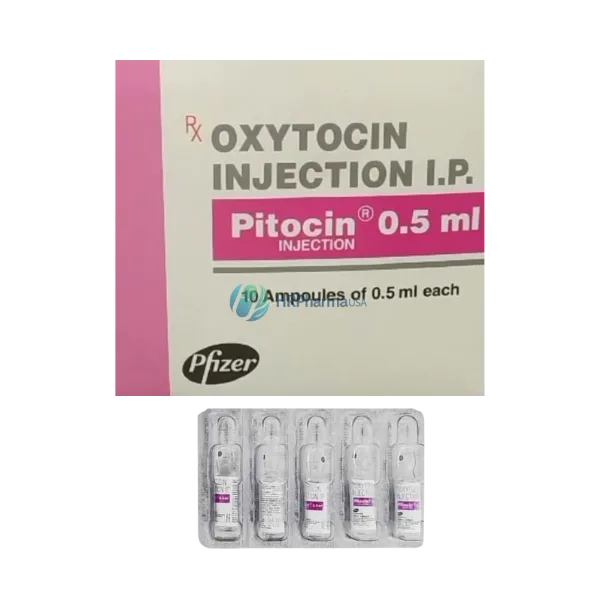
Pitocin 5 iu Injection (Oxytocin)
Pitocin 5 IU Injection (Oxytocin) is a prescription uterotonic medicine used by healthcare professionals to stimulate uterine contractions during medically indicated labour and to help control postpartum bleeding.
| Active Ingredient: | Oxytocin |
|---|---|
| Indication: | Induction of labor |
| Manufacturer: | Pfizer Ltd. |
| Packaging: | 10 Ampoules in Pack |
| Strength: | 0.5ml |
| Delivery Time: | 6 To 15 days |
Pitocin 5 iu Injection (Oxytocin)
| Variant | Price | Units | Quantity | Add to Cart |
|---|---|---|---|---|
| 10 Ampoule/s | $15.00 | $1.5 / Ampoule | ||
| 30 Ampoule/s | $35.00 | $1.17 / Ampoule | ||
| 60 Ampoule/s | $60.00 | $1 / Ampoule |
Product Description About Pitocin 5 iu Injection
Pitocin 5 IU Injection (Oxytocin) contains oxytocin, a synthetic form of the natural hormone involved in uterine contractions during labour. Oxytocin injection is a prescription medicine used in obstetric care and should be administered only by trained healthcare professionals in an appropriate medical setting.
An important point about the product strength is that current labelling for branded Pitocin lists oxytocin at 10 units/mL. A 5 IU/mL oxytocin injection strength is available in some international markets, but a current marketed branded Pitocin 5 IU/mL presentation could not be verified. The exact vial, concentration, manufacturer, and labelling should therefore be checked before this product is supplied or described as a Pitocin presentation.
What Is Pitocin Oxytocin Injection?
Pitocin is a brand of synthetic oxytocin injection. Oxytocin acts mainly on the smooth muscle of the uterus and helps increase the strength and frequency of uterine contractions.
The medicine may be used when a healthcare professional decides that starting or strengthening labour contractions is medically necessary. It may also be used after childbirth to help the uterus contract and reduce bleeding caused by poor uterine contraction.
Current prescribing information lists Pitocin for medically indicated induction of labour, stimulation or reinforcement of labour in selected cases, certain pregnancy-related medical procedures, and management of postpartum uterine bleeding or haemorrhage. It is not indicated simply for elective induction of labour when there is no medical reason for induction.
How Does Oxytocin Injection Work?
Oxytocin attaches to receptors in the uterus and causes the uterine muscles to contract. During labour, these contractions can help support cervical changes and the progress of delivery when induction or augmentation is medically appropriate.
After delivery, continued uterine contraction is also important because it helps compress blood vessels in the uterus. For this reason, oxytocin is commonly used in medical settings when uterine contraction is needed to help manage postpartum bleeding.
The response to oxytocin can vary considerably from one patient to another. Healthcare professionals monitor the strength and frequency of contractions and adjust treatment according to the individual clinical situation.
Medical Uses of Pitocin Injection
- Medically indicated induction of labour
- Strengthening or improving contractions when labour is not progressing as expected
- Supporting uterine contraction during the third stage of labour
- Helping control postpartum bleeding related to poor uterine contraction
- Adjunctive treatment in selected cases of incomplete or inevitable abortion
How Is Pitocin Given?
Oxytocin injection is administered by healthcare professionals. For induction or stimulation of labour, current Pitocin labelling states that it should be given by controlled intravenous infusion under adequate medical supervision in a hospital.
The amount required is not the same for every patient. The healthcare team considers uterine response, contraction pattern, stage of labour, maternal condition, fetal condition, and the reason oxytocin is being used.
Continuous observation is especially important during intravenous oxytocin treatment because excessive uterine activity can create serious risks for both the mother and baby.
Important Safety Information
Pitocin should not be used when vaginal delivery would create an unacceptable risk or when certain obstetric conditions make oxytocin inappropriate.
Examples listed in current prescribing information include significant mismatch between the baby’s size and the mother’s pelvis, certain fetal positions that cannot be safely delivered vaginally, fetal distress when delivery is not close, an already overactive uterus, total placenta previa, cord presentation or prolapse, and known hypersensitivity to oxytocin.
Previous major uterine surgery, uterine overdistention, some placental problems, and other pregnancy complications may also affect whether oxytocin is appropriate.
Because each pregnancy is different, treatment decisions should be based on direct medical assessment rather than general dosing information.
Possible Side Effects
Oxytocin can cause adverse reactions, particularly when uterine contractions become too strong or prolonged.
Reported maternal reactions include nausea, vomiting, changes in blood pressure, abnormal heart rhythm, postpartum bleeding, excessive uterine contractions, and, in severe cases, uterine rupture.
Large amounts of oxytocin given over an extended period can also affect the body’s handling of water. Serious water intoxication, seizures, and coma have been reported in association with prolonged high-dose administration.
Changes in uterine activity can also affect the fetus. This is one reason fetal heart rate and uterine contractions are closely monitored when Pitocin is used during labour.
Available Strengths and Presentations
5 IU/mL Oxytocin
Pitocin 10 Units/mL
- 10 units/mL in a 1 mL single-dose vial
- 100 units/10 mL, equal to 10 units/mL, in a multiple-dose vial
Generic Oxytocin Injection
- 10 units in a 1 mL single-dose vial
- 100 units in a 10 mL multiple-dose vial
- 300 units in a 30 mL multiple-dose vial
Pitocin 5 IU Injection Substitutes and Alternatives
Products containing the same active ingredient may be considered alternatives when the concentration, dosage form, route, clinical purpose, and prescribing requirements are appropriate.
Current labeled options include:
Pitocin Oxytocin Injection 10 units/mL: Branded synthetic oxytocin supplied by Par Health USA in single-dose and multiple-dose vial presentations.
Oxytocin Injection, USP 10 units/mL by Fresenius Kabi: A prescription synthetic oxytocin injection available in several vial sizes while maintaining a concentration of 10 units/mL.
Other generic oxytocin injection products may also be available through institutional pharmaceutical suppliers. Availability can change, and products with different concentrations or vial sizes should not be treated as automatically interchangeable.
Any substitution should be determined by the prescribing clinician, pharmacist, or healthcare institution using the exact product labelling and required concentration.
FAQs
1. How should Pitocin or oxytocin injection be stored?
2. Is Pitocin a controlled substance?
3. What should be done if an oxytocin vial looks cloudy or contains particles?
4. Is there a missed-dose problem with Pitocin?
5. Is the expiration date the same for every Pitocin or oxytocin vial?
| size | 10 Ampoule/s, 30 Ampoule/s, 60 Ampoule/s |
|---|
Please sign in to My Account to leave a review.
Reviews
There are no reviews yet.