
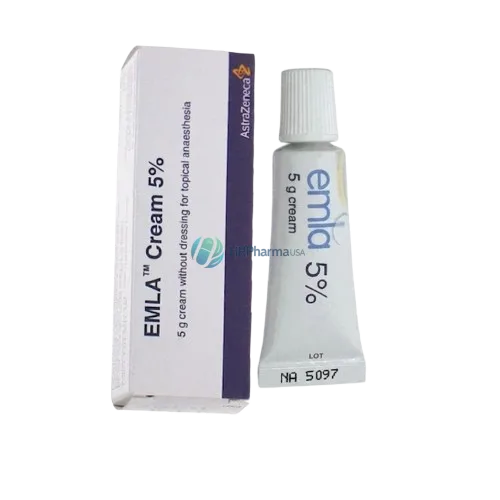
Emla Cream 5g (Lidocaine and Prilocaine)
| Active Ingredient | Lidocaine and Prilocaine |
|---|---|
| Indication | Temporary numbing of skin |
| Manufacturer | AstraZeneca |
| Packaging | 5 gm |
| Strength | 2.5% lidocaine and 2.5% prilocaine |
| Delivery Time | 6 to 15 days |
Emla Cream 5g (Lidocaine and Prilocaine)
| Variant | Price | Units | Quantity | Add to Cart |
|---|---|---|---|---|
| 1 Cream | $6.49 | $6.49 / Cream | ||
| 3 Cream/s | $26.02 | $8.67 / Cream | ||
| 7 Cream/s | $59.77 | $8.53 / Cream |
Info About Emla Topical Anaesthetic Numbing Cream 5G
Emla Cream 5g (Topical Anaesthetic Numbing Cream) is a prescription topical anesthetic cream containing two local anesthetics, lidocaine 2.5% and prilocaine 2.5%. Together, these ingredients temporarily reduce sensation in the area where the cream is applied. This can make certain medical procedures involving the skin more comfortable.
Each gram of lidocaine and prilocaine cream contains 25 mg of lidocaine and 25 mg of prilocaine. The combination is commonly described as a 5% topical anesthetic formulation because the two active ingredients together make up 5% of the cream.
The 5g marking refers to the amount of cream in the tube. It should not be confused with the medicine strength.
What Is Emla Cream Used For?
Emla Cream is mainly used to provide temporary local numbness before certain procedures. Prescription lidocaine and prilocaine 2.5%/2.5% cream is indicated for local pain control on normal, intact skin. It is also labeled for certain procedures involving genital mucous membranes when used under appropriate medical supervision.
A healthcare professional may prescribe a topical numbing cream before procedures such as:
-
Needle insertion
-
Blood sampling
-
Placement of an IV line
-
Certain injections
-
Minor skin procedures
-
Other procedures where temporary surface numbness is needed
The exact reason for using Emla Cream depends on the procedure and the patient’s age, health, and treatment plan.
How Does Emla Numbing Cream Work?
Lidocaine and prilocaine are local anesthetics. They temporarily block the nerve signals that normally carry pain and other sensations from the treated area to the brain.
The effect is local, which means the cream works mainly in the area where it is applied. It does not work like an oral pain medicine that travels throughout the body.
Enough time needs to be allowed for the medicine to pass through the outer layer of the skin. The amount applied, size of the treatment area, age of the patient, and length of application can all affect how much medicine is absorbed.
How to Use Emla Cream 5g
Use Emla Cream exactly according to the prescription label or instructions given by the healthcare professional managing the procedure.
For use on intact skin, current lidocaine and prilocaine labeling states that the cream is generally applied at least 1 hour before a routine procedure and about 2 hours before procedures expected to be more painful. The correct amount and maximum treatment area depend on the patient’s age, weight, procedure, and application time.
Do not simply apply a larger amount because stronger numbness is wanted. Using too much cream, covering too large an area, or leaving it on longer than recommended can increase absorption into the bloodstream and raise the risk of serious side effects.
The cream should generally be used on normal, intact skin unless a healthcare professional specifically directs otherwise for an approved medical procedure.
Common Side Effects
Temporary skin changes can happen where lidocaine and prilocaine cream is applied. These effects are often mild and may disappear after the cream is removed.
Possible local reactions include:
-
Pale or whitened skin
-
Redness
-
Mild swelling
-
Itching
-
Changes in temperature sensation
-
Burning or unusual sensation at the application site
-
Rare skin rash
Clinical labeling reports that temporary paleness and redness are among the more frequently observed local effects on intact skin.
Seek medical help if there is severe swelling, trouble breathing, hives, widespread rash, or another sign of a serious allergic reaction.
Important Safety Information
Emla Cream should not be used by someone with a known allergy to lidocaine, prilocaine, other amide-type local anesthetics, or another ingredient in the product.
The cream should not normally be applied to open wounds. Extra care is also required around the eyes and in situations where the medicine could enter the middle ear.
A rare but serious problem associated with local anesthetics is methemoglobinemia, a condition that reduces the blood’s ability to carry oxygen. Risk may be higher in people with G6PD deficiency, certain inherited blood conditions, heart or lung problems, very young infants, or people taking medicines that can also cause methemoglobinemia.
Blue, gray, or unusually dark coloring of the lips, skin, or nail beds, along with symptoms such as shortness of breath, severe dizziness, unusual tiredness, confusion, or a fast heartbeat, requires prompt medical attention.
People taking certain heart rhythm medicines, including some class III antiarrhythmic drugs, should also discuss Emla Cream with their prescriber because cardiac effects may be additive.
Available Strength and Pack Sizes
Emla-type lidocaine and prilocaine cream is commonly supplied at one standard combination strength:
Lidocaine 2.5% + Prilocaine 2.5%
This equals:
-
Lidocaine 25 mg per gram
-
Prilocaine 25 mg per gram
-
5% combined active anesthetic concentration
Current prescription generic products in the U.S. market are available in 5g tubes and 30g tubes. The 30g option contains more cream but does not provide a stronger concentration.
Available pack sizes can vary between manufacturers and markets, so the package supplied by a pharmacy may differ.
Substitutes and Alternatives
The closest substitute is generic Lidocaine and Prilocaine Cream USP 2.5%/2.5%. Current U.S. prescription labels show this same active ingredient combination in both 5g and 30g tube sizes.
Another type of topical anesthetic available on the market is lidocaine 4% cream, including products such as LMX4. Lidocaine 4% products contain lidocaine alone rather than the lidocaine and prilocaine combination. Some are sold as OTC topical anesthetics for specific labeled uses.
Lidocaine 4% cream should not automatically be treated as a direct replacement for Emla Cream. The ingredients, approved uses, application instructions, and expected effects are different. A pharmacist or prescriber can determine which topical anesthetic is suitable for a particular procedure.
FAQs
1. How should Emla Cream be stored?
Lidocaine and prilocaine cream is generally stored at controlled room temperature, around 68°F to 77°F (20°C to 25°C). Current labeling permits limited temperature excursions between 59°F and 86°F (15°C to 30°C). Keep the container tightly closed and away from children.
2. Can Emla Cream be used during pregnancy or breastfeeding?
Pregnant or breastfeeding patients should discuss its use with their healthcare professional before applying it. Lidocaine, and probably prilocaine, can pass into human milk, so prescription labeling recommends caution during breastfeeding.
3. Can Emla Cream be used before tattooing, waxing, or laser treatments?
These cosmetic uses should not automatically be assumed to be the same as its prescription-labeled medical uses. Some healthcare professionals may use topical anesthetics for cosmetic procedures, but the appropriate product, amount, treatment area, and application time should be determined by the professional performing or supervising the procedure.
4. What should I do if Emla Cream gets into my eye?
Immediately rinse the eye thoroughly with water or saline. Because local anesthetics can temporarily reduce the eye’s protective sensation, the eye should be protected until normal sensation returns. Seek medical care if pain, irritation, or vision problems continue.
5. Can Emla Cream be used together with another lidocaine or numbing product?
Do not combine topical anesthetics without checking with a healthcare professional. When lidocaine or prilocaine is used in more than one product, the total amount from all sources needs to be considered because repeated or combined doses can raise drug levels in the body.
| size | 1 Cream, 3 Cream/s, 7 Cream/s |
|---|
Please sign in to My Account to leave a review.



Reviews
There are no reviews yet.