A difficult sexual experience can stay in your head long after the moment itself has passed. Perhaps you could not get an erection, or you became erect but lost it halfway through sex. The next day, the questions begin: Was it stress? Was it the alcohol? Is something medically wrong? Most of all, how long does temporary erectile dysfunction last?
For some men, the answer is a few hours. For others, it may be several days or weeks. When medication, surgery, illness, or nerve irritation is involved, recovery can take months.
There is no universal timer because temporary ED is not one specific condition with one predictable recovery period. It is a symptom, and the timeline depends on its cause.
An occasional erection problem is common and is often linked to tiredness, stress, or drinking too much alcohol. When the problem keeps returning, however, it may be connected to a physical condition, an emotional issue, medication, or several factors working together.
The Quick Answer
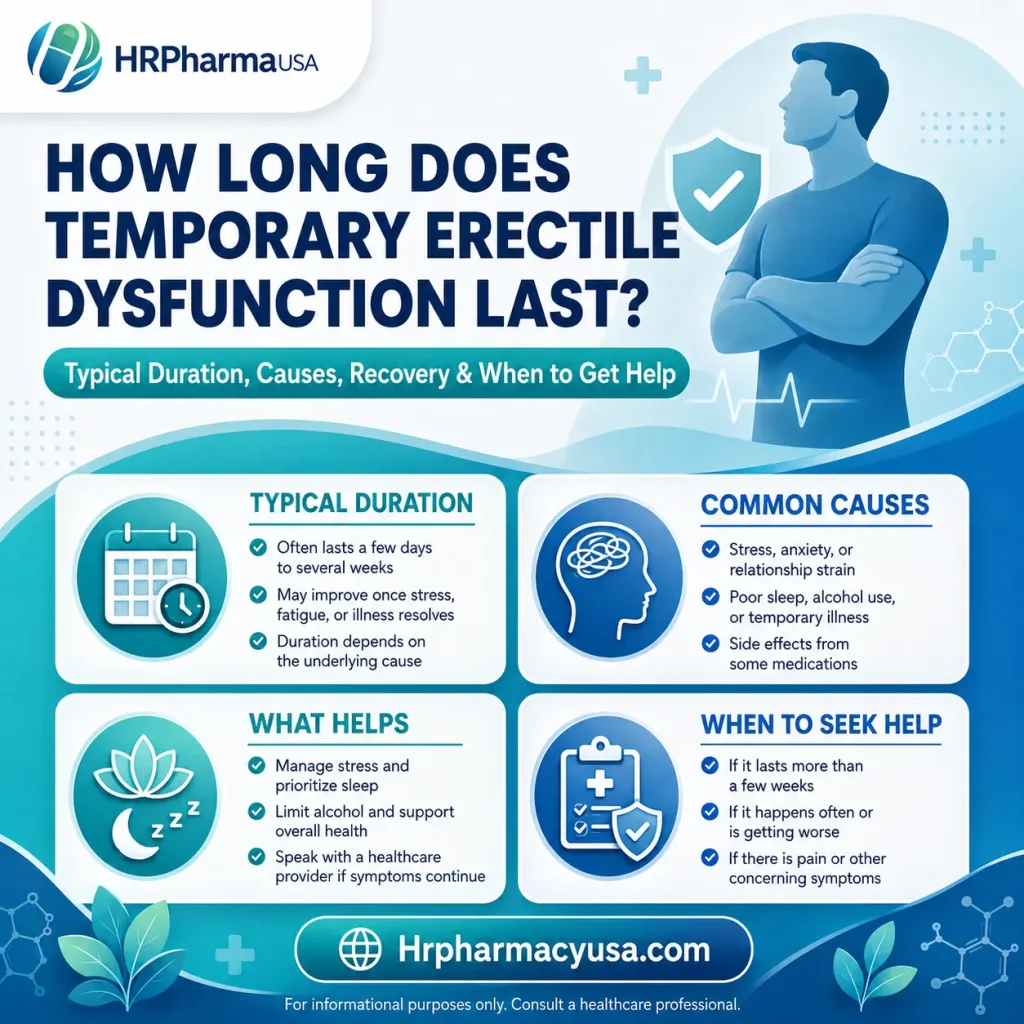
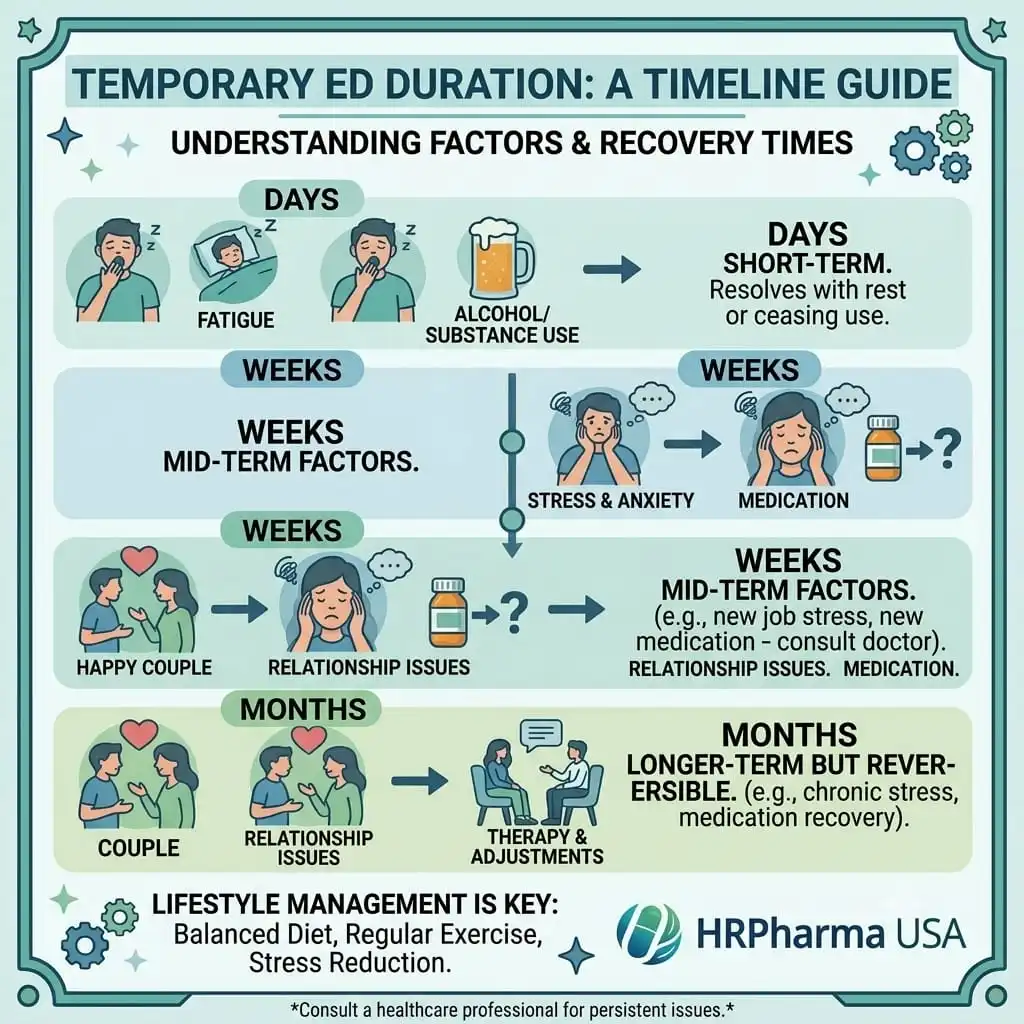
Temporary erectile dysfunction can last:
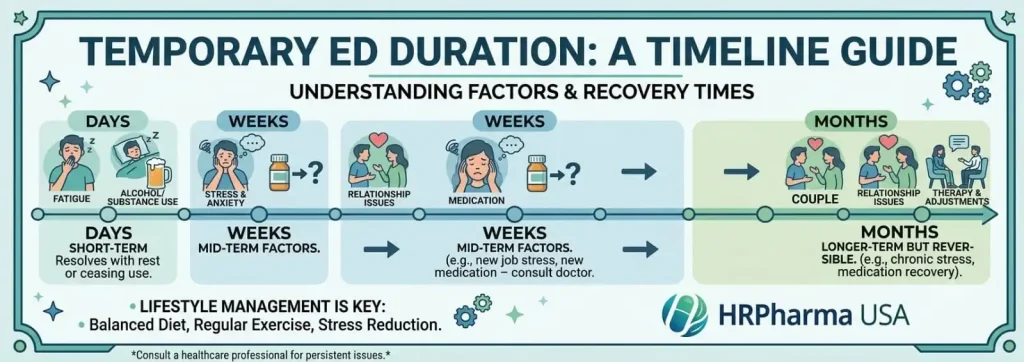
- A few hours when it is related to intoxication, distraction, or a brief stressful moment.
- A few days when exhaustion, poor sleep, illness, or a hangover is involved.
- Several weeks when ongoing stress, relationship tension, or performance anxiety is driving the problem.
- Several months or longer, when recovery depends on surgery, medication changes, or nerve healing.
These are broad patterns, not medical deadlines. The cause matters much more than the number of days that have passed.
A man who loses his erection after several drinks is in a different situation from someone whose erections have gradually weakened over six months. Treating both cases as “temporary ED” would overlook a crucial difference.
What Temporary Erectile Dysfunction Actually Means
Erectile dysfunction means being unable to get or maintain an erection firm enough for sexual activity. Temporary ED describes erection difficulty that appears for a limited period or only under particular circumstances.
The erection process is more delicate than it seems. Sexual interest begins in the brain, nerve signals travel through the body, blood vessels relax, and blood flows into the penis. Muscles then help keep that blood in place. Hormones, mood, sensation, and physical health all influence the process.
That is why a person can feel attracted to a partner and still not get an erection. Desire is important, but desire alone does not override fear, fatigue, medication effects, or poor circulation.
One Difficult Night Does Not Necessarily Mean ED
Bodies are not machines that deliver identical results every time. A man may have no difficulty on Friday and struggle on Saturday because he is exhausted, distracted, or worried.
One unsuccessful attempt does not prove that anything is permanently wrong. In fact, most men occasionally fail to get or keep an erection, often because of stress, tiredness or excess alcohol.
The trouble often starts after the first incident. Instead of treating it as an off night, a man may interpret it as evidence that he has “lost” his sexual ability. That conclusion creates anxiety, and anxiety can make the next attempt more difficult.
The original physical problem may have lasted 20 minutes. The worry about it can last much longer.
When “Temporary” Starts Looking Persistent
There is no official point at which temporary ED suddenly becomes permanent. The pattern is more revealing than the calendar.
Pay attention when the difficulty:
- Happens during most sexual encounters.
- Occurs during masturbation as well as partnered sex.
- Has become gradually worse.
- Is accompanied by fewer morning or spontaneous erections.
- Started after a new medicine, operation, or injury.
- Comes with reduced sexual desire, pain, numbness, or penile curvature.
- Continues even when you are relaxed and well-rested.
Ongoing erection trouble can sometimes be associated with diabetes, cardiovascular disease, hormonal problems, nerve disorders, or other health conditions. ED may also be a side effect of medication or may be worsened by emotional difficulties.
How Long Does Temporary ED Last in Different Situations?
The phrase “temporary ED recovery time” sounds as though there should be a standard answer. In reality, every cause produces a different pattern.
Performance Anxiety and Situational ED
Situational ED may happen only with a partner, only with a new partner, or only when intercourse feels especially important.
A common example is a man who has normal erections during masturbation but struggles during partnered sex. Physically, his erection system may still work. The difficulty appears when expectation and self-consciousness enter the room.
Performance anxiety erectile dysfunction may resolve during the next comfortable sexual experience. It may also continue for weeks or months when every encounter feels like another examination.
Imagine someone learning to drive while an examiner watches every movement. Even simple actions suddenly feel awkward. Sexual performance anxiety can create a similar effect. The person stops experiencing the moment and starts evaluating himself from the outside.
The Fear–Failure Cycle
The cycle usually looks like this:
An erection problem happens once. The person worries that it will happen again. During the next encounter, he closely monitors his erection. That monitoring creates tension and interrupts arousal. The erection weakens, which appears to confirm the fear.
Trying harder often makes matters worse. Erections are supported by relaxation, not by mentally shouting instructions at the body.
Situational ED often improves when penetration is temporarily removed as the main goal. Touch, kissing, oral sex, massage, and other forms of closeness can rebuild comfort without forcing the erection to “prove” anything.
Stress-Induced Erectile Dysfunction
How soon does ED resolve after stress? Sometimes it improves as soon as the stressful event is over. More often, the body needs time to settle.
A difficult meeting may affect one evening. Months of financial pressure, family conflict or workplace burnout may affect sexual function for much longer.
Stress does not stay neatly inside the mind. It changes sleep, concentration, mood and behaviour. A stressed person may drink more, move less, eat poorly and remain mentally occupied during sex. By the time an erection problem appears, several causes may be operating together.
If the source of stress continues, waiting alone may not fix the problem. Recovery usually requires some change in the situation, the response to it, or both.
Alcohol-Related Erection Problems
Alcohol can reduce nervousness, which may seem helpful at first. After a certain point, however, it can interfere with sensation, arousal, and the nerve signals involved in maintaining an erection.
How long after drinking does ED last? For a one-off episode, erectile function may return later that night, the next morning or after the hangover has passed. The timing depends on how much alcohol was consumed, how quickly it was consumed, whether food was eaten, sleep quality, hydration and other substances.
A useful clue is repetition. If erection difficulty regularly appears after several drinks but not when sober, alcohol is probably contributing.
Frequent heavy drinking is a different issue. Over time, it may affect nerves, hormones, the liver, and cardiovascular health. In that case, the problem may not disappear simply because the person skips alcohol for one evening.
Temporary ED After Poor Sleep or Exhaustion
Sometimes the explanation is less dramatic: the person is simply worn out.
Sexual arousal requires attention and energy. Someone who has slept badly for several nights may want intimacy emotionally but have little physical response.
When exhaustion is the main cause, erections may return after one or two good nights of sleep. Chronic sleep deprivation may take longer to correct because it often comes with irritability, stress, reduced exercise and lower sexual interest.
A single lazy Sunday will not necessarily undo three months of four-hour nights. Consistency matters more than one unusually long sleep.
Persistent snoring, gasping during sleep, morning headaches or severe daytime sleepiness should also be discussed with a clinician because they may point to a sleep disorder rather than ordinary tiredness.
Depression, Anxiety and Emotional Health
Depression can reduce sexual desire, energy and emotional connection. Anxiety can leave the mind racing when it needs to slow down.
There is no fixed timeline for depression and temporary ED. Someone going through a brief anxious period may improve within days or weeks. A person with persistent depression may need longer-term treatment before sexual function feels normal again.
Mental health and erectile dysfunction recovery are also complicated by medication. Certain antidepressants and other medicines can affect libido, orgasm, or erections. At the same time, untreated depression itself can cause sexual problems.
It is therefore risky to assume that the medicine is solely responsible. The condition, the medicine, or both may be involved.
Medication Side Effects
Medication-related erection problems may begin after:
- Starting a new prescription.
- Increasing a dose.
- Adding another medicine.
- Switching brands or formulations.
- Combining medication with alcohol or recreational substances.
How long medication side-effect ED lasts depends on the drug, its dose, and how the treatment is managed. Some men improve after their clinician adjusts the prescription. Others need an alternative treatment or direct support for ED.
The worst approach is stopping essential medication without advice. A blood pressure drug, antidepressant, or heart medicine may be protecting the person from a far more serious problem.
Blood Pressure Medicines and Antidepressants
Temporary ED from high blood pressure medicines is possible, but the situation is rarely as simple as “the pill caused it.”
High blood pressure can damage blood vessels, including the vessels involved in erections. Depression can reduce desire and arousal. The medicine may contribute, but the untreated illness can contribute too.
A clinician can review when symptoms began, compare the timing with medication changes, and decide whether another option is appropriate. The decision should be based on the person’s full health picture, not on sexual side effects alone.
Smoking, Nicotine and Reduced Blood Flow
An erection depends heavily on blood flow, and nicotine narrows blood vessels. Smoking also contributes to longer-term vascular damage.
Temporary ED after smoking does not have a neat recovery period. Some immediate effects may fade as nicotine leaves the body. Damage associated with years of smoking takes longer to improve and may not be completely reversible.
Quitting still matters. It supports cardiovascular health and removes a factor that may be making erections less reliable.
Vaping should not automatically be treated as harmless in this context. Products containing nicotine can still affect blood vessels, even when no tobacco smoke is present.
Illness and Temporary Erectile Dysfunction
The body rarely prioritises sex while dealing with fever, pain, infection or dehydration.
A mild illness may affect erections for a few days. A severe infection, hospital stay or prolonged recovery can affect energy and sexual function for weeks.
Medications used during the illness may add another layer. Painkillers, sleep disruption, reduced appetite and fear about health can all change sexual response.
When the illness improves, erectile function often improves with it. When it does not, a medical review can help determine whether the illness revealed an existing circulation, hormone or nerve problem.
Temporary ED After Surgery
After an operation, the body is managing pain, medication, inflammation, limited movement and psychological stress. Even surgery far from the genitals can temporarily reduce sexual interest or performance.
The post-operative erectile dysfunction timeline depends heavily on the procedure.
Following a relatively minor operation, erections may return as energy and comfort improve. After pelvic, bladder, colorectal or prostate surgery, recovery can take considerably longer because the nerves and blood vessels involved in erections may be affected.
Recovery After Prostate or Pelvic Surgery
Erectile dysfunction is a recognised complication of radical prostatectomy. Even with nerve-sparing surgery, early recovery of natural erections is not common because the nerves may be stretched, bruised or temporarily impaired.
Some men notice progress within months. For others, improvement continues over a much longer period. Age, erectile function before surgery and how successfully the nerves were preserved all affect recovery.
This does not mean a person should passively wait for a year or two. Urologists may discuss penile rehabilitation, prescription tablets, vacuum devices, injections or other treatments during recovery.
The surgeon or urologist is the right person to provide an individual timeline because the details of the operation matter.
Nerve Irritation or Injury
Nerves carry the signals that begin an erection. If they are compressed, inflamed, stretched, or damaged, sexual function may change.
Recovery from temporary nerve-related ED can take weeks or months. A mild compression injury may settle relatively quickly. More serious damage can heal slowly or leave lasting symptoms.
Sudden ED after pelvic trauma or spinal injury deserves medical assessment. Seek urgent care when erection difficulty appears with severe back pain, leg weakness, numbness around the groin, or loss of bladder or bowel control.
How Can You Tell Whether ED Is Psychological or Physical?
People often want a clean answer: “Is it in my head, or is it in my body?” That division is misleading because physical and psychological causes frequently overlap.
A psychological component is more likely when the problem begins suddenly, varies by situation, and does not affect morning erections or masturbation. A physical cause becomes more likely when the change is gradual, happens in every setting, and comes with reduced spontaneous erections.
Neither pattern proves anything by itself.
A mild circulation problem, for example, may cause one weak erection. The next time, anxiety takes over. The person now has both a physical vulnerability and a psychological trigger.
Diagnosis may involve a medical, sexual, and mental health history, a physical examination, and selected laboratory or other tests.
Also read about What Are PDE5 Inhibitors for Erectile Dysfunction? Doctor Explained
What Can Make Temporary ED Last Longer?
The obvious cause is not always the only cause.
Suppose poor sleep triggers the first episode. The man then becomes anxious, avoids intimacy, and drinks before sex to relax. Alcohol weakens the erection again. Relationship tension develops because his partner feels rejected.
What began as fatigue is now being maintained by anxiety, alcohol, and poor communication.
Temporary ED often lasts longer when a person:
- Repeatedly tests his erection.
- Avoids all intimacy out of embarrassment.
- Hides the issue from his partner.
- Uses more alcohol to reduce anxiety.
- Buys unregulated supplements.
- Ignores an underlying health condition.
- Stops medication without medical supervision.
- Treats every imperfect erection as a failure.
Recovery is usually faster when the maintaining factors are identified rather than when the person simply waits.
How to Fix Temporary Erectile Dysfunction
There is no single natural remedy that ends every case of temporary ED. The effective response depends on the cause.
Stop Turning Sex Into a Performance Test
An erection is more likely to appear when attention is on pleasure rather than measurement.
For a while, remove the demand for penetration. Agree with your partner that intimacy does not have to end in intercourse. This creates room for arousal to return without pressure.
It also helps to say what is happening. A simple explanation—“I’m attracted to you, but I’ve been anxious and tired”—can prevent the partner from inventing a more painful explanation.
Restore Sleep and Reduce Stress
Stress management does not require a perfect morning routine or an hour of meditation.
Start with practical changes: a regular bedtime, fewer work messages at night, daily movement, and honest attention to the problem causing the stress.
Breathing exercises may calm the body in the moment, but they cannot solve an impossible workload or unresolved relationship conflict. Addressing the source is often more useful than endlessly managing the symptoms.
Exercise and Support Healthy Blood Flow
Regular exercise supports cardiovascular health, sleep, mood, and weight management. These benefits can also support erectile function.
Walking briskly, swimming, cycling, or doing resistance training consistently is more useful than completing one exhausting workout and then stopping.
Healthy eating and physical activity may help reduce ED risk and improve symptoms, especially when blood-vessel health is part of the problem.
Pelvic-floor exercises may help some men, but technique matters. They are one possible tool, not a guaranteed cure for every form of situational ED.
Limit Alcohol and Stop Smoking
When alcohol repeatedly causes erection problems, experiment with having less—or none—before sex.
Do not replace alcohol with an unknown “male enhancement” product. Some unregulated supplements contain undeclared ingredients or interact with prescription medicines.
Stopping smoking supports blood-vessel health. Improvement may be gradual, but the change benefits far more than sexual performance.
Speak to a Doctor Before Changing Medication
Write down:
- Every medicine and supplement you take.
- When the erection problem began.
- Any dose changes around that time.
- Whether the problem happens every time or only sometimes.
- Whether morning erections have changed.
This gives the clinician something concrete to assess.
Do not abruptly stop antidepressants, blood pressure medicines, or other prescriptions. A doctor may adjust the dose, change the medicine, or recommend an ED treatment while continuing essential care.
Consider Counselling or Sex Therapy
Counselling can be useful when anxiety, depression, relationship strain, or past sexual experiences are affecting arousal.
Sex therapy is not simply talking about feelings. It may include structured exercises designed to reduce performance pressure, rebuild touch and improve communication.
NIDDK includes counselling, lifestyle changes and ED medicines among recognised approaches to treating erectile dysfunction.
Do ED Medicines Help With Temporary ED?
Prescription medicines such as Cenforce (sildenafil) or Tadalafil can help many men by improving blood flow during sexual stimulation.
They may be useful while a temporary cause is being addressed, particularly when repeated failures have damaged confidence. However, they do not create desire, eliminate relationship tension or guarantee an erection without arousal.
They are also not suitable for everyone. In particular, ED medicines can interact dangerously with nitrate medicines used for chest pain.
A clinician should review medical history, cardiovascular health and current medication before recommending treatment.
Buying pills from an unknown online seller is not a shortcut. It replaces one uncertain problem with another.
When Should You See a Doctor?
There is no need to wait for an arbitrary three-month mark when something feels wrong.
Arrange a medical appointment when erection difficulties keep returning, are becoming more frequent, or are causing significant worry. It is especially important to seek advice when symptoms begin after surgery, injury, or medication changes, or when they occur alongside diabetes, high blood pressure, heart disease, pain, numbness, reduced desire, or penile curvature.
Ongoing ED can sometimes signal a health condition that needs treatment. Mayo Clinic notes that persistent erection problems may be related to an underlying health issue and can also be associated with heart disease risk.
Seek urgent care for an erection lasting more than four hours. That condition is called priapism and is a medical emergency, not a sign of healthy sexual function.
Conclusion
So, how long does temporary erectile dysfunction last?
It may disappear after a night of sleep, once alcohol wears off, or during the next relaxed sexual experience. Stress-induced ED may remain for several weeks, particularly when the stress continues. Medication-related ED depends on how treatment is managed, while recovery after pelvic or prostate surgery can take months or longer.
The label “temporary” should not become an excuse to ignore a repeating problem. Look at when the difficulty happens, what changed before it began, and whether erections still occur at other times.
Reduce pressure, get enough sleep, limit alcohol intake, support cardiovascular health, and speak openly with your partner. When the problem keeps returning, consult a healthcare professional. Most causes of ED can be managed, but the right solution starts with identifying the real cause rather than guessing at the timeline.
Frequently Asked Questions
Can temporary erectile dysfunction last for a month?
Yes. Temporary ED may last for a month when ongoing stress, performance anxiety, depression, medication effects, or recovery from illness is involved. A month does not automatically mean the condition is permanent, but recurring symptoms are worth discussing with a doctor.
How long does performance anxiety ED last?
Performance anxiety ED may resolve after one reassuring sexual experience, or it may continue for weeks or months if every encounter creates more fear. Reducing the focus on penetration, communicating with your partner, and considering sex therapy can help break the cycle.
How long does alcohol-related ED last?
After one night of drinking, erection problems may improve within hours or by the following day. Heavy or frequent alcohol use may have longer-lasting effects and should not be treated as a harmless temporary cause.
Can lack of sleep cause temporary ED?
Yes. Poor sleep can reduce energy, concentration, mood, and sexual interest. If exhaustion is the main cause, erectile function may improve after several nights of proper sleep. Long-term sleep problems may require more consistent changes or medical evaluation.
When should I worry about temporary ED?
Seek medical advice when the problem keeps happening, becomes gradually worse, occurs during masturbation as well as partnered sex, or comes with pain, numbness, reduced morning erections, or other health symptoms. You should also speak with a clinician if ED begins after surgery, an injury, or a medication change.