
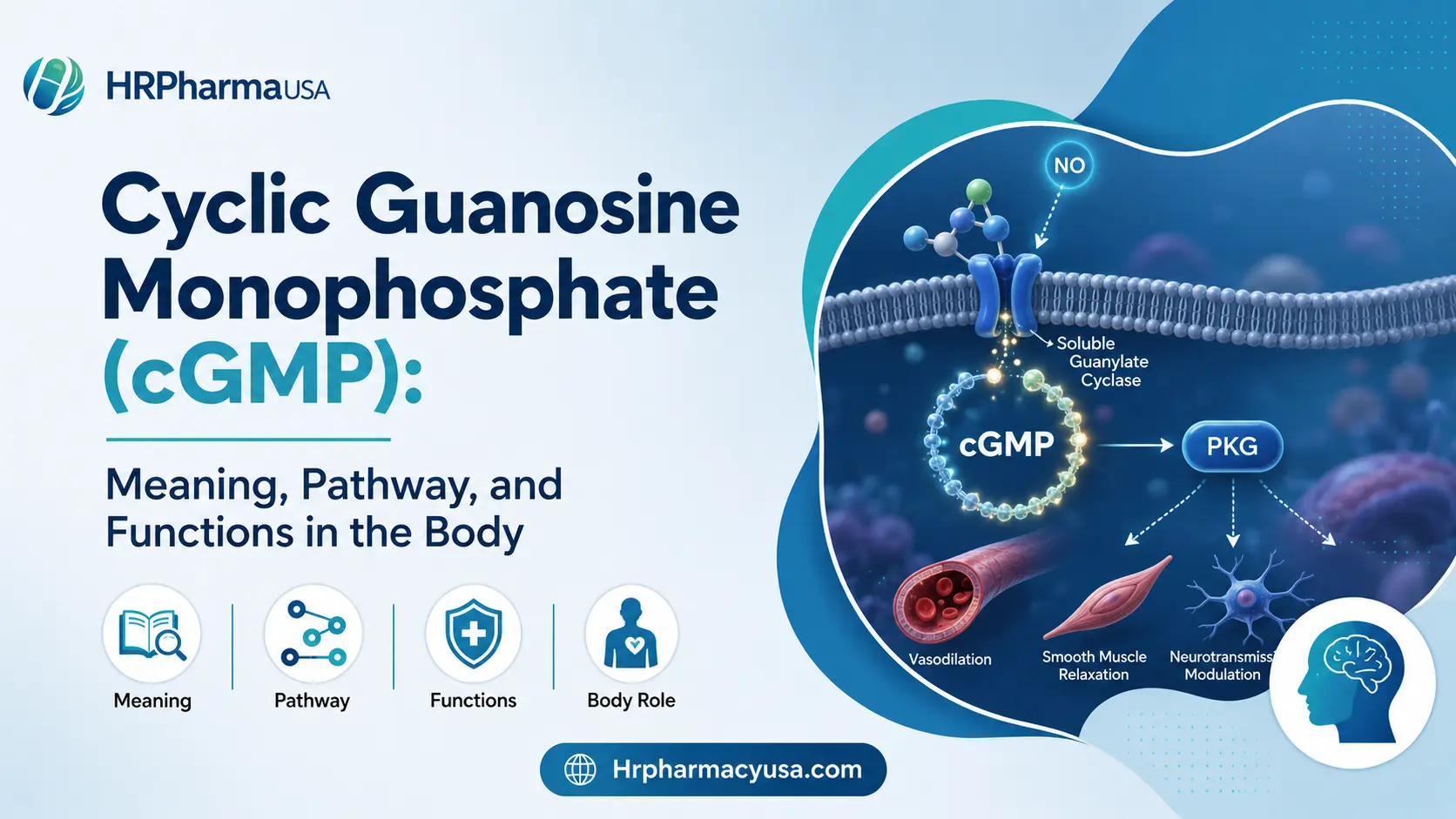
Cyclic guanosine monophosphate, usually shortened to cGMP or cyclic GMP, is a small signaling molecule that helps cells respond to hormones, nitric oxide, light, and other biological signals. It plays a part in blood vessel relaxation, heart function, vision, kidney activity, intestinal fluid movement, nerve signaling, and erectile function.
Think of a cell as a busy office building. A hormone or chemical signal may arrive at the front door, but it still needs a way to deliver instructions to workers inside. cGMP acts like an internal message sent through the building. It carries information from a receptor or enzyme to proteins that can change how the cell behaves.
The cGMP signaling pathway is also an important target for several prescription medicines. PDE5 inhibitors, soluble guanylyl cyclase stimulators, and certain gastrointestinal medicines work by increasing cGMP or extending its effects. These treatments are used for specific medical conditions, but changing cGMP activity can also affect blood pressure and interact with other medicines.
What Is Cyclic Guanosine Monophosphate?
Cyclic guanosine monophosphate is a naturally produced cyclic nucleotide. Its full chemical name is guanosine 3′,5′-cyclic monophosphate.
Cells produce cGMP from guanosine triphosphate, commonly called GTP. GTP is an energy-carrying nucleotide that also serves as the starting material for several important signaling molecules.
cGMP is not a hormone, vitamin, mineral, or protein. It is an intracellular messenger. This means that cells generally make it when they receive a signal and then break it down once the message has been delivered.
cGMP Meaning and Definition
The abbreviation cGMP can be broken down into two parts:
- The letter c means cyclic.
- GMP means guanosine monophosphate.
The word cyclic describes the arrangement of the phosphate group in the molecule. The phosphate forms a ring by connecting to the 3′ and 5′ positions of the ribose sugar.
Biologically, cGMP is defined as a second messenger that transfers signals within cells. It may activate protein kinases, regulate ion channels, change calcium movement, and influence other signaling systems. PubChem identifies cyclic GMP as a guanine nucleotide with a phosphate group joined to both the 3′ and 5′ positions of its sugar component.
cGMP Molecule, Structure, and Formula
Lorem Ipsum has been the industry’s standard dummy text ever since the 1500s.
The molecular formula of cyclic guanosine monophosphate is C10H12N5O7P. Its structure contains three main parts:
- A guanine base
- A ribose sugar
- A cyclic phosphate group
The cyclic phosphate is the feature that separates cGMP from ordinary guanosine monophosphate. Instead of attaching at only one position, the phosphate forms a ring across the sugar.
This structure allows cGMP to fit into specific binding areas on proteins such as protein kinase G, cyclic nucleotide-gated channels, and certain phosphodiesterase enzymes. The fit works somewhat like a key entering a lock. When cGMP binds, it can change the protein’s shape and activity.
Why Is cGMP Called a Second Messenger?
A first messenger is a signal that begins outside the cell. It may be a hormone, neurotransmitter, nitric oxide molecule, or natriuretic peptide.
The first messenger usually cannot complete the entire job by itself. Instead, it activates a receptor or enzyme that creates a second messenger inside the cell. cGMP is one of these second messengers.
The process can be pictured as a relay race. The external signal carries the baton for the first part of the race. cGMP then takes the baton and carries the message through the cell.
A second messenger offers several advantages. It can amplify a weak signal, spread the message to different cell areas, activate several proteins at once, and stop the response quickly when the signal is no longer needed.
How the cGMP Signaling Pathway Works
The cGMP signaling pathway is not a single rigid pathway. Different tissues use different receptors, enzymes, and target proteins. The general sequence is still similar:
- A signal reaches a cell.
- Guanylyl cyclase becomes active.
- Guanylyl cyclase converts GTP into cGMP.
- cGMP activates target proteins.
- Phosphodiesterase enzymes break down cGMP.
Each step is controlled carefully. Too little signaling may weaken the desired response, while too much signaling may cause unwanted effects.
Signal Reception
Lorem Ipsum has been the industry’s standard dummy text ever since the 1500s.
The process begins when a signaling molecule reaches its target.
Nitric oxide can move through cell membranes and activate an enzyme inside the cell. Natriuretic peptides and intestinal peptides usually bind to receptors on the cell surface. Light activates a different signaling chain inside retinal photoreceptor cells.
The type of signal determines which guanylyl cyclase enzyme produces cGMP and where the cGMP signal appears inside the cell.
cGMP Synthesis by Guanylyl Cyclase
Guanylyl cyclase, also called guanylate cyclase, is the enzyme responsible for cGMP synthesis. It converts GTP into cyclic GMP.
There are two main forms of this enzyme.
Soluble Guanylyl Cyclase
Soluble guanylyl cyclase, shortened to sGC, is found inside cells. It is a major receptor for nitric oxide.
When nitric oxide binds to sGC, the enzyme becomes more active and produces cGMP. This nitric oxide, sGC, and cGMP system is especially important in blood vessels and the cardiovascular system.
FDA prescribing information for vericiguat explains that nitric oxide binding to sGC leads to intracellular cGMP production. The resulting signal helps regulate vascular tone, heart function, and related cardiovascular processes.
Membrane Guanylyl Cyclase
Membrane guanylyl cyclases are receptors that sit within the cell membrane. Part of the receptor faces outside the cell, while its enzyme section faces inward.
When a signaling molecule binds to the outer section, the inner section produces cGMP.
Examples include receptors for atrial natriuretic peptide, brain natriuretic peptide, C-type natriuretic peptide, guanylin, and uroguanylin. These systems are involved in blood pressure control, sodium balance, intestinal secretion, bone development, and other functions.
Activation of cGMP Target Proteins
Once cGMP has been produced, it binds to proteins that carry out the cell’s response.
Major cGMP target proteins include:
- Protein kinase G
- Cyclic nucleotide-gated ion channels
- Phosphodiesterase enzymes
- Other regulatory proteins
The exact result depends on the type of cell and the proteins present in it.
Protein Kinase G
Protein kinase G, commonly shortened to PKG, is one of the best-known cGMP targets. It is also called cGMP-dependent protein kinase.
When cGMP binds to PKG, the enzyme becomes active and adds phosphate groups to selected proteins. This process is called phosphorylation.
PKG can affect calcium levels, smooth muscle tension, ion movement, gene activity, and platelet behavior. In vascular smooth muscle, PKG activity helps reduce calcium availability and supports relaxation. Experimental work has shown that type I cGMP-dependent protein kinase is a key part of the pathway that lowers cellular calcium and promotes vasorelaxation.
There are two main types of cGMP-dependent protein kinase:
- PKG type I, found mainly in smooth muscle, platelets, and several other tissues
- PKG type II, associated with intestinal function, bone growth, and selected nervous system processes
cGMP-Gated Ion Channels
Lorem Ipsum has been the industry’s standard dummy text ever since the 1500s.
Some ion channels open or close when cGMP binds to them. These are known as cyclic nucleotide-gated channels.
They are especially important in vision. Photoreceptor cells in the retina use changes in cGMP to control the movement of sodium and calcium ions across the cell membrane.
cGMP-regulated channels are also found in parts of the sensory and nervous systems. By controlling electrical activity, they help convert chemical signals into nerve signals.
cGMP Breakdown by Phosphodiesterase Enzymes
A signal needs an off switch. Without one, cells could remain active long after the original message had disappeared.
Phosphodiesterase enzymes, or PDEs, provide this off switch. They break the cyclic phosphate bond in cGMP and convert it into noncyclic 5′-GMP.
PDE activity controls the strength, location, and duration of cGMP signaling. Some PDEs mainly break down cGMP, while others act on both cGMP and cyclic adenosine monophosphate, known as cAMP.
The Nitric Oxide and cGMP Pathway
The nitric oxide-cGMP pathway is one of the most studied signaling systems in human biology.
It can be summarized as:
Nitric oxide activates soluble guanylyl cyclase, soluble guanylyl cyclase produces cGMP, cGMP activates PKG, and PKG changes calcium handling and smooth muscle activity.
How Nitric Oxide Raises cGMP
Nitric oxide synthase enzymes make nitric oxide from the amino acid L-arginine. The nitric oxide can then move into nearby smooth muscle cells.
Inside the smooth muscle cell, nitric oxide binds to soluble guanylyl cyclase. The activated enzyme converts GTP into cGMP.
The amount of cGMP rises quickly, activates PKG, and produces a series of cellular changes. Phosphodiesterase enzymes eventually clear the cGMP and limit the response.
How cGMP Relaxes Blood Vessels
Smooth muscle contraction depends partly on calcium. Higher levels of available calcium encourage the muscle to contract. Reducing calcium activity allows the muscle to relax.
The cGMP-PKG pathway can:
- Reduce calcium entry into the cell
- Support calcium storage or removal
- Decrease the sensitivity of contractile proteins to calcium
- Affect potassium channels
- Reduce the activity of proteins involved in contraction
When vascular smooth muscle relaxes, the blood vessel becomes wider. This is known as vasodilation.
The process is similar to loosening a tight belt around a hose. The wider space allows blood to move with less resistance.
Main Functions of cGMP in the Body
cGMP does not have one single job. Its function changes according to the tissue, source of the signal, local enzymes, and target proteins.
Cardiovascular Function
The cardiovascular system uses cGMP to help control vascular tone, circulation, heart stress responses, and platelet activity.
Blood Pressure and Vasodilation
Lorem Ipsum has been the industry’s standard dummy text ever since the 1500s.
Nitric oxide released from blood vessel lining cells can increase cGMP in nearby smooth muscle. The resulting relaxation helps regulate blood flow and blood pressure.
Natriuretic peptides can also raise cGMP through membrane guanylyl cyclase receptors. These hormones are released when the heart is under pressure or stretched by increased blood volume.
The effects of cGMP are not identical in every blood vessel. Local PDE activity, receptor expression, disease, age, and other factors can change the response.
Heart and Platelet Function
Within the heart, cGMP signaling may influence relaxation, contractility, remodeling, and responses to mechanical stress. The pathway interacts with cAMP and calcium signals, so its effects may depend on the exact cellular location where cGMP is produced.
cGMP also helps regulate platelet activation. Platelets are small blood components involved in clot formation. Research using real-time cGMP imaging suggests that cGMP may act as a braking signal that limits excessive platelet growth and vessel blockage.
cGMP in the Nervous System
Neurons use cGMP for several forms of communication and signal control. It may affect neurotransmitter release, ion channels, nerve growth, synaptic strength, sensory processing, and cellular responses to nitric oxide.
Some research connects cGMP signaling with learning and memory. These effects are complex and should not be reduced to the idea that simply increasing cGMP will improve memory.
The brain contains many cell types, PDE enzymes, and signaling compartments. A rise in cGMP that helps one process may have little effect or a different effect elsewhere.
Research has also shown that cGMP-dependent protein kinase participates in the guidance and connection of certain sensory nerve fibers during development.
cGMP in Vision and Phototransduction
Phototransduction is the process that turns light into an electrical signal in the retina. cGMP is central to this process in rod and cone photoreceptor cells.
What Happens in Darkness
In darkness, cGMP levels in the outer part of a photoreceptor remain relatively high. cGMP binds to cyclic nucleotide-gated channels and helps keep them open.
Sodium and calcium ions enter the cell through these channels. This keeps the photoreceptor in a relatively depolarized state.
What Happens When Light Reaches the Retina
When light activates a visual pigment such as rhodopsin, a signaling cascade turns on PDE6. PDE6 breaks down cGMP.
As the cGMP concentration falls, the cGMP-gated channels close. Ion entry decreases, the photoreceptor becomes more negatively charged, and the release of neurotransmitter changes.
The retina then passes this information through other cells toward the brain. Research on rod photoreceptors shows that the location and timing of the cGMP decrease contribute to the reliable response to individual photons.
Mutations affecting PDE6, cGMP-gated channels, guanylyl cyclases, or related proteins can disrupt retinal signaling. Some of these changes are associated with inherited retinal disorders, though the exact condition depends on the affected gene.
cGMP in the Kidneys
The kidneys use cGMP signals from nitric oxide and natriuretic peptides. These signals may influence renal blood flow, sodium handling, filtration structures, and communication between kidney cell types.
Atrial natriuretic peptide can promote sodium excretion, also called natriuresis, through pathways that include cGMP. The response helps the body manage blood volume.
Modern imaging research has shown that kidney endothelial cells and podocytes can produce different cGMP patterns after stimulation. This finding highlights an important point: cGMP is not spread evenly through an organ. Its effects can be highly local and cell specific.
cGMP in the Digestive System
The intestinal lining contains guanylate cyclase-C receptors. Natural peptides such as guanylin and uroguanylin can activate these receptors and raise cGMP.
Higher intracellular cGMP can activate the CFTR ion channel, increase chloride and bicarbonate movement into the intestine, draw in water, and speed intestinal transit.
The prescription medicine linaclotide uses this pathway. It activates guanylate cyclase-C on the intestinal surface, raising intracellular and extracellular cGMP. According to its FDA label, the intracellular signal supports chloride and bicarbonate secretion, while extracellular cGMP may reduce the activity of pain-sensing nerves in animal models.
This is a good example of how the same second messenger can have a different job in another organ. In a blood vessel, cGMP may relax smooth muscle. In the intestine, it may increase fluid movement and affect pain signaling.
cGMP and Sexual Health
cGMP plays a major role in penile erection.
Sexual stimulation causes nerves and blood vessel lining cells to release nitric oxide. Nitric oxide activates soluble guanylyl cyclase, which raises cGMP inside smooth muscle cells in penile tissue.
The cGMP signal relaxes smooth muscle and allows more blood to enter. An erection becomes possible when blood inflow increases and blood is retained within the erectile tissue.
PDE5 breaks down cGMP and helps end the response. PDE5 inhibitor medicines do not create cGMP from nothing and do not directly produce sexual desire. They slow cGMP breakdown, allowing the natural nitric oxide signal to last longer.
Current sildenafil labeling describes the medicine as a selective inhibitor of cGMP-specific PDE5. It also warns that sildenafil can strengthen the blood pressure-lowering effects of nitrate medicines.
Phosphodiesterase Enzymes That Control cGMP
Humans have 11 major phosphodiesterase families. Their tissue locations, regulation, and preferred substrates differ.
The PDE family involved in one tissue may be less important in another. This is why a PDE inhibitor can produce a strong effect in one organ and a smaller effect elsewhere.
PDE5, PDE6, and PDE9
PDE5, PDE6, and PDE9 are generally considered cGMP-selective enzymes.
PDE5 is found in vascular smooth muscle, penile tissue, platelets, and other tissues. It is a major target of sildenafil, tadalafil, vardenafil, and avanafil.
PDE6 is central to visual signaling in retinal photoreceptors. Light activates PDE6, lowering cGMP and closing cGMP-gated channels.
PDE9 has a high affinity for cGMP and is found in several tissues, including the brain, kidneys, and cardiovascular system. PDE9 inhibitors remain an area of medical research, but research interest should not be confused with proof that these medicines treat every condition linked with cGMP.
PDE1, PDE2, PDE3, PDE10, and PDE11
PDE1, PDE2, PDE3, PDE10, and PDE11 can act on both cGMP and cAMP, although their preference and regulation vary.
PDE2 and PDE3 are especially important in communication between cGMP and cAMP pathways. For example, a change in cGMP can alter PDE2 or PDE3 activity, which may then change local cAMP levels.
This cross-talk shows why cell signaling is more like a connected road system than a single straight road. Changing one route can redirect traffic across several others.
Medicines That Affect the cGMP Pathway
Several medicine groups target cGMP signaling. They do not all work in the same way.
Some prevent cGMP breakdown. Others stimulate its production. Another group activates a receptor that creates cGMP in the intestinal lining.
PDE5 Inhibitors
PDE5 inhibitors block the enzyme responsible for breaking down cGMP in selected tissues.
Examples include:
- Sildenafil
- Tadalafil
- Vardenafil
- Avanafil
These medicines are used for conditions such as erectile dysfunction and certain forms of pulmonary hypertension, depending on the specific medicine and formulation.
They extend the action of existing cGMP. They do not replace the need for nitric oxide signaling. In erectile function, sexual stimulation is still required for the natural pathway to begin.
Soluble Guanylyl Cyclase Stimulators
Soluble guanylyl cyclase stimulators increase cGMP production by acting directly on sGC.
Riociguat is used for selected forms of pulmonary hypertension. Vericiguat is used for selected adults with symptomatic chronic heart failure after a recent worsening event.
Vericiguat stimulates sGC both independently of and together with nitric oxide. Its FDA labeling states that this raises intracellular cGMP and supports smooth muscle relaxation and vasodilation.
Riociguat also acts on the nitric oxide-sGC-cGMP pathway. It must not be combined with PDE5 inhibitors, nitrates, or other sGC stimulators because the combination may cause excessive blood pressure reduction.
Guanylate Cyclase-C Agonists
Guanylate cyclase-C agonists act mainly within the intestine.
Linaclotide is one example. It raises cGMP at the intestinal surface, leading to increased intestinal fluid and faster transit. It is prescribed for specific constipation-related conditions.
Because it acts locally in the digestive tract, its use and safety profile are different from medicines that increase cGMP throughout the cardiovascular system.
Important Safety Considerations
Increasing cGMP is not automatically beneficial. The effect depends on the tissue, dose, medical condition, and other medicines being taken.
Excessive activity in the cardiovascular system can cause:
- Low blood pressure
- Dizziness
- Weakness
- Fainting
- Headache
- Flushing
Combining nitrate medicines with PDE5 inhibitors may cause a dangerous fall in blood pressure. Combining riociguat with PDE5 inhibitors is also contraindicated. These medicines should only be used according to approved prescribing instructions and professional medical guidance.
cGMP Levels and Laboratory Testing
Scientists measure cGMP to study cell signaling, drug activity, disease mechanisms, and responses to hormones or nitric oxide.
Measuring cGMP is not as simple as measuring blood glucose. cGMP levels may change within seconds, differ between cell compartments, and be affected by how a sample is collected and stored.
Blood and Urine Testing
cGMP can be measured in blood, plasma, tissue, cells, or urine. Urinary cGMP has sometimes been studied as a marker of natriuretic peptide activity and cardiovascular stress.
There is no single universal “normal cGMP level” that can be applied to every sample type, laboratory, age group, or medical condition.
A result must be interpreted according to:
- The type of sample
- The testing method
- Collection timing
- Storage conditions
- Kidney function
- Medicines
- The laboratory’s reference range
- The reason the test was ordered
Routine cGMP testing is not commonly used by itself to diagnose erectile dysfunction, high blood pressure, heart disease, memory problems, or retinal disease.
ELISA, Mass Spectrometry, and Biosensors
Laboratories may measure cGMP using:
- Enzyme-linked immunosorbent assays
- Competitive immunoassays
- Radioimmunoassays
- Fluorescence assays
- Liquid chromatography
- Mass spectrometry
- FRET-based biosensors
- BRET-based biosensors
ELISA kits are useful for measuring cGMP in prepared samples. Mass spectrometry can offer high chemical specificity but requires specialized equipment and careful sample preparation.
Fluorescent biosensors allow researchers to observe cGMP changes inside living cells. High-affinity FRET-based sensors can detect low cGMP concentrations and show where and when a signal appears.
BRET-based methods can also measure changing cGMP activity in live cells and are useful for testing many samples or potential drug compounds.
Difference Between cGMP and cAMP
cGMP and cAMP are both cyclic nucleotide second messengers, but they are not interchangeable.
cGMP is made from GTP by guanylyl cyclase. It commonly activates protein kinase G and cGMP-gated channels.
cAMP is made from ATP by adenylyl cyclase. It commonly activates protein kinase A and other cAMP-binding proteins.
Both systems control ion channels, enzymes, calcium activity, gene expression, and metabolism. Their effects still depend on the tissue and the location of the signal inside the cell.
The two pathways can interact through PDE enzymes. PDE2, for example, can be activated by cGMP and then increase cAMP breakdown. PDE3 can be inhibited by cGMP under some conditions, allowing cAMP to rise.
This means the cGMP-to-cAMP ratio is not simply a health score. It is a changing local relationship within specific cells.
cGMP in Plants and Microorganisms
cGMP signaling is not limited to humans and animals.
In plants, studies have linked cGMP with growth, ion transport, stress responses, defense signaling, and communication with calcium pathways. The exact enzymes and mechanisms are not always the same as those found in mammals.
Research in Arabidopsis suggests that cGMP can influence responses to salt and osmotic stress by affecting ion transport and stress-related gene activity.
Some bacteria can also use 3′,5′-cyclic GMP, although its role is less widely understood than mammalian cGMP signaling. Research in Xanthomonas campestris identified an enzyme involved in bacterial cGMP production and linked the pathway with bacterial behavior.
Cyclic GMP should not be confused with cyclic di-GMP. Cyclic di-GMP contains two guanine nucleotides and is a separate bacterial second messenger involved in processes such as biofilm formation, movement, and environmental adaptation. Its chemical structure is different from that of ordinary cyclic GMP.
Cyclic GMP vs Current Good Manufacturing Practice
The abbreviation cGMP has two completely different meanings.
In cell biology and medicine, cGMP means:
Cyclic guanosine monophosphate
In pharmaceutical manufacturing, CGMP means:
Current Good Manufacturing Practice
Current Good Manufacturing Practice refers to regulatory requirements for how medicines are manufactured, processed, packed, tested, stored, and controlled.
FDA CGMP regulations establish minimum requirements for manufacturing methods, facilities, and controls. Their purpose is to help ensure that a medicine contains the ingredients and strength stated on its label and is produced under suitable quality systems.
The two meanings are unrelated:
- Cyclic GMP is a molecule inside cells.
- Manufacturing CGMP is a quality and regulatory system.
- Cyclic GMP affects biological signaling.
- Manufacturing CGMP affects how products are made and controlled.
Context usually makes the intended meaning clear. A discussion about nitric oxide, PDE5, cells, or blood vessels refers to cyclic guanosine monophosphate. A discussion about FDA inspections, pharmaceutical facilities, documentation, or quality control refers to Current Good Manufacturing Practice.
What High or Low cGMP Levels May Mean
The meaning of a high or low cGMP level depends entirely on where it is measured.
A high concentration inside intestinal cells may increase fluid secretion. A temporary increase in vascular smooth muscle may support relaxation. A decrease in retinal photoreceptor cGMP is a normal part of the response to light.
This is why statements such as “high cGMP is good” or “low cGMP is bad” are misleading.
Abnormal cGMP signaling may result from changes in:
- Nitric oxide production
- Guanylyl cyclase activity
- PDE activity
- Receptor function
- Kidney clearance
- Cell structure
- Medicine use
- Genetic variants
Researchers study altered cGMP signaling in cardiovascular disease, pulmonary hypertension, retinal disorders, kidney disease, neurological conditions, and other areas. An association does not always mean that cGMP is the main cause or that increasing it will treat the condition.
Conclusion
Cyclic guanosine monophosphate is a small molecule with a wide reach. It carries signals inside cells, links nitric oxide with blood vessel relaxation, helps retinal cells respond to light, supports intestinal secretion, contributes to kidney signaling, and plays an important part in erectile function.
Its activity depends on a balance between production and breakdown. Guanylyl cyclase enzymes produce cGMP, while phosphodiesterase enzymes remove it. Proteins such as PKG and cGMP-gated ion channels translate the signal into a cellular response.
Medicines can target nearly every part of this system, but the same mechanism that produces a useful effect can also create safety risks. cGMP-related treatments should therefore be understood as targeted medical tools, not general methods for boosting circulation, sexual performance, memory, or overall health.
Frequently Asked Questions
Is cGMP a hormone?
No. cGMP is an intracellular second messenger. Hormones and other first messengers may trigger its production, but cGMP normally carries the signal within the cell rather than traveling through the body as a hormone.
Can food or supplements directly increase cGMP?
No food has been proven to safely and predictably raise cGMP in specific human tissues in the same controlled way as a prescription medicine. Some nutrients may support nitric oxide production, but their effects depend on digestion, health, dose, and many other factors.
Is cGMP the same as cGAMP?
No. cGMP is cyclic guanosine monophosphate. cGAMP is cyclic guanosine monophosphate-adenosine monophosphate, a different molecule involved in immune signaling through the cGAS-STING pathway.
Can cGMP be checked with a routine blood test?
It can be measured using specialized laboratory methods, but it is not part of a standard blood panel. A single blood result may not represent the short-lived and highly local cGMP signals occurring inside organs and cells.
Why is combining nitrate medicine with a PDE5 inhibitor dangerous?
Nitrates increase nitric oxide signaling and cGMP production, while PDE5 inhibitors slow cGMP breakdown. Using them together can cause cGMP activity to rise too much, leading to a severe and potentially dangerous fall in blood pressure.